Japanese kitchen knives are named for the job they were shaped for. Most modern home knives are double-bevel (ground on both sides, easy for right- and left-handers); traditional fish knives are single-bevel (ground on one side, made in right- and left-handed versions).
Lengths, bevels and levels are typical values; each maker varies, so check the details of the piece you choose.

Gyuto (chef’s knife)
- Length
- Usually 210–240 mm (range about 180–270 mm).
- Bevel
- Double.
- Profile
- The Japanese equivalent of the Western chef’s knife; long, with a curved belly and a pointed tip.
- Best for
- Meat, fish and vegetables; everyday preparation.
- Not for
- Cutting through bones or frozen food (thin Japanese blades can chip).
- Level
- Beginner to professional.
- Compared with
- Longer and more pointed than a santoku; the usual first “big” knife.

Santoku (“three virtues”)
- Length
- Typically 165–180 mm.
- Bevel
- Double.
- Profile
- Shorter and more compact than a gyuto, with a flatter edge and a rounded “sheepsfoot” tip.
- Best for
- Everyday cooking: meat, fish and vegetables.
- Not for
- Bones and frozen food.
- Level
- The usual first Japanese knife for beginners.
- Compared with
- Like a bunka, but with a rounded tip; shorter than a gyuto.
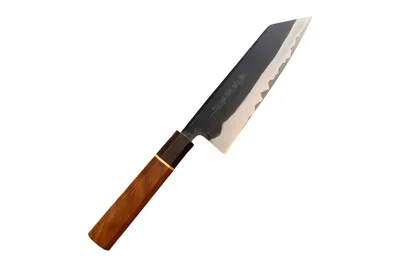
Bunka
- Length
- 165–180 mm (some makers up to 210 mm).
- Bevel
- Double.
- Profile
- All-purpose, similar in size to a santoku, with a reverse-tanto (“k-tip”) point for detail work.
- Best for
- General home cooking; the angled tip helps with precise cuts.
- Not for
- Bones and frozen food.
- Level
- Beginner to intermediate.
- Compared with
- The santoku has a rounded tip and is easier to learn; the bunka has the finer tip.

Nakiri (vegetable knife)
- Length
- Usually 165–180 mm.
- Bevel
- Double.
- Profile
- Rectangular, flat blade; the whole edge touches the board.
- Best for
- Push-cutting and chopping vegetables.
- Not for
- Meat on the bone, and rock-chopping (the blade has no belly).
- Level
- Beginner-friendly.
- Compared with
- Like a vegetable-only santoku, with a square tip and no point.

Petty (utility knife)
- Length
- About 120–150 mm (up to 180 mm).
- Bevel
- Double.
- Profile
- A small all-round knife for work in the hand or on a small board.
- Best for
- Peeling fruit, trimming fat, small preparations and detail work.
- Not for
- Heavy chopping or large ingredients; use a gyuto or a santoku.
- Level
- Beginner to professional.
- Compared with
- The small partner of a gyuto or a santoku, not a replacement.

Boning knife (Honesuki)
- Length
- 145–165 mm (some sources up to 180 mm).
- Bevel
- Single or double, depending on the maker.
- Profile
- Short, triangular, rigid blade with a pointed tip.
- Best for
- Breaking down poultry and following the joints; it relies on leverage and precise tip control.
- Not for
- Fine slicing (use a sujihiki) or general chopping.
- Level
- Intermediate to professional.
- Compared with
- Much shorter and stiffer than a sujihiki: a sujihiki slices boneless meat, a honesuki separates it from the bone.

Funayuki (“fishing boat” knife)
- Length
- Usually 150–210 mm; sizes from 105 to 240 mm exist.
- Bevel
- Varies: usually ground on both sides, but single-bevel and double-bevel versions exist.
- Profile
- Lighter and thinner than a deba, agile.
- Best for
- Originally filleting and preparing fish on fishing boats; today meat, fish and vegetables at home.
- Not for
- Bones or frozen food.
- Compared with
- The lightweight cousin of the deba; it does not cut through fish bones.

Koyanagi (small slicer)
- Length
- Common sizes are 135, 150 and 180 mm.
- Bevel
- Most are double-bevel; the traditional yanagiba is single-bevel, so check the model.
- Profile
- “Ko” means small: a compact yanagiba.
- Best for
- Filleting and slicing small fish, such as aji (Japanese horse mackerel).
- Not for
- Bones, frozen food and heavy preparation.
- Compared with
- A short yanagiba for small fish and home use; a sujihiki is longer and also works for meat.

Sujihiki (slicer)
- Length
- About 240–300 mm.
- Bevel
- Double.
- Profile
- Long, narrow blade that slices in long, smooth strokes.
- Best for
- Boneless meat, cooked and raw (roast beef, carving), fish fillets, sashimi.
- Not for
- Deboning, cutting bones or breaking down whole fish.
- Level
- Intermediate to professional.
- Compared with
- The gyuto is the all-rounder; the sujihiki is the specialist for slicing. A yanagiba also slices fish, but it is single-bevel and harder to learn.

Yanagiba (sashimi knife)
- Length
- Usually 270–300 mm (up to 330 mm).
- Bevel
- Single. Right- and left-handed versions are made.
- Profile
- A long, thin, single-bevel slicer.
- Best for
- Slicing raw fish for sashimi and sushi in one long pull.
- Not for
- Bones, and hard or frozen food.
- Level
- Advanced / professional (for sushi chefs, mastering it is “a rite of passage”).
- Compared with
- A sujihiki cuts more kinds of food and is double-bevel, so it is easier to start with.

Deba (fish-butchering knife)
- Length
- About 150–210 mm.
- Bevel
- Single.
- Profile
- Thick, heavy blade with a single-bevel edge.
- Best for
- Breaking down whole fish, including heads and small bones.
- Not for
- Fine slicing work.
- Level
- Intermediate to advanced; not recommended for beginners unless they prepare Japanese-style fish.
- Compared with
- A funayuki is lighter and thinner; a yanagiba is the knife that slices the fillet afterwards.
Not sure which to choose?
Message us and we will help you pick based on what you cook.